



Glass Shattered
In the summer of 1940, soaring above the clouds 17,000 feet above Britain, the Allies and enemy German fighter planes filled the sky. Bright flashes of light illuminate the horizon, and smoke rises all around. Inside the cockpit, the cacophony of bullets raining around the plane and the rattling of the metal panels resonate. From the dogfight of the other planes, a stray bullet whizzes past. As the bullet makes contact with the cockpit canopy, plastic shards shatter into a million pieces, a few of which fly into the fighter pilot’s eye. Blinded in both eyes, with the plane spiraling into a nose-dive, he could feel the world spinning around him as he plummeted into the ground. Struggling to free himself from the grasp of the plane’s restraints among the shards of broken plastic, he finally undoes the seat belt’s harness and makes a blind leap of faith. Free-diving through the air, his panic increases as he blindly fumbles for the cord, unsure of how close to the ground he is. Finally, he manages to find the cool metal of the parachute’s ripcord and pulls it, allowing him to drift back down to safety.
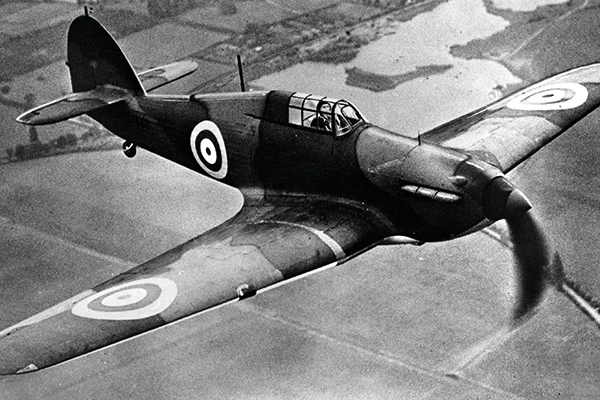
Once on the ground and escorted back to the military hospital for treatment, Dr. Harold Ridley, a British ophthalmologist, oversaw the pilot’s injuries. This pilot’s name was Gordon “Mouse” Cleaver, a Squadron leader in the U.K Royal Air Force. With both of his eyes having fragments of the plastic canopy lodged in them, Cleaver was left completely blind in one eye and severely vision-impaired in the other. Over the course of the next few years, Ridley performed countless tedious surgeries on the pilot in order to remove the plastic fragments. During these surgeries, Ridley noticed that the plastic shards in his eyes didn’t cause
any inflammation or adverse effects that were expected of foreign substances being stuck in the eye. Being exposed to countless soldiers losing their vision due to eye trauma, Ridley was always interested in a way to preserve patients' vision. As a result, after discovering a material compatible within the eye, Ridley pondered what would happen if he created compatible artificial lenses to replace the damaged lenses in eyes of patients that suffered from cataracts, a common eye disease. These artificial lenses would later be known as intraocular lenses.

Typically, cataracts form as a result of aging, when the proteins in the lens of the eye deteriorate over time and become more cloudy, leading to vision loss. The image below, borrowed from Delaware Ophthalmology, shows a comparison of a healthy lens to one with cataracts. During World War II, the incidence of eye diseases, like cataracts, dramatically increased. The exposure of flying debris and toxic chemicals, like aviation fuel, caused many soldiers to develop cataracts from the eye trauma.
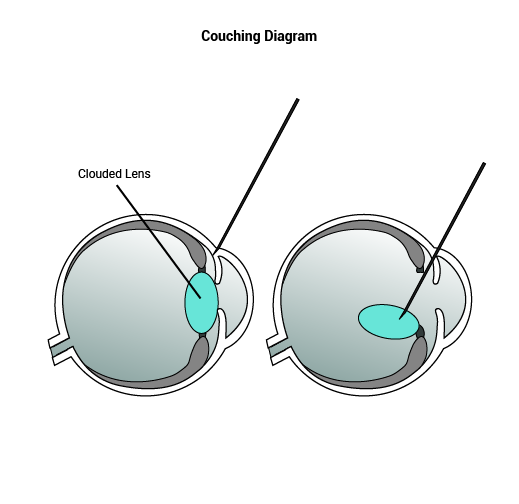
Prior to and during World War II, doctors treating cataracts had very limited options, including only couching and extracapsular extraction. In couching, doctors would use a sharp, needle-like instrument to push the patient’s clouded lens to the back of their eye, out of their vision. The other form of treatment for cataracts was extracapsular extraction. In this procedure, the surgeon removes the cataract by making a large incision in the eye and taking out the cloudy lens. A pioneering eye surgeon, Dr. Peter Choyce, described the state of affairs of cataracts before World War II in an interview hosted on YouTube. He recalled how “200 years prior, it was just removing the soft matter of the lens,” and patients were left blind, or had to have cataract glasses, which were “big, thick, heavy horrible things in order to see.” Ridley himself criticized these treatments, saying, “that the cataract operation without a replacement lens was an incomplete, only half-finished operation.” As a way to resolve this incomplete procedure, Ridley invented the intraocular lens. As an article in the medical journal StatPearls explains, “This realization paved the way for the development of the intraocular lenses, one of the most important advances in eye surgery of the 20th century.”

While in modern society, the intraocular lens may seem like a simple procedure and treatment for cataracts, countless years of development, planning, and challenges arose with its creation. During an interview hosted on YouTube, Ridley voices how he wanted to “copy nature as closely as possible” since he believed that “God doesn’t make many mistakes.” As a result, after years of painstaking research, Ridley and his research team made a material similar to the plastic found in Cleaver’s eye as a way to “copy” nature. The goal, Ridley explained, was “giving natural sight. Back to square one. A new pair of eyes.” Later, in 1949, Ridley performed the first implantation of an intraocular lens in a patient with no serious complications and successfully restored their vision. Encouraged by this initial success, Ridley went on to implant about a thousand intraocular lenses over the course of a few years. For these following cases, complications did exist in a significant number, namely in errors with IOL power, inflammatory reactions to the sterilization method, and corneal decompensation. In multiple patients, the intraocular lenses no longer worked after it got dislocated due to the excessive weight of the implant. Because of these complications, Ridley eventually abandoned his original IOL design. However, his pioneering concept of the intraocular lens inspired further research and innovation, leading others to refine and improve IOL designs to make them more compatible with the eye.
While the initial surgery of the intraocular lens is considered a major success in the ophthalmology field, Ridley still faced intense criticism from the British medical establishment and his peers, to the point of causing him to suffer from severe depression. In a medical journal written by ophthalmology professionals, they described the pressure Ridley felt, and how “compounded by the professional jealousy, fear of innovation, and unjustified skepticism,” it caused his work to not be accepted for decades. Surgeons argued that with the intraocular lens, they “were going backwards by putting a fine body in the eye.” Even to people that had close relations with Ridley, they were strongly against his idea. Ridley remembers fantasizing about “how nice it would be to put a new lens in.” His father, an ophthalmologist, however, quashed Ridley’s statement. He bluntly stated, “It’s impossible. It is dangerous. The eyes are very delicate organs.” His mentor also agreed, expressing that, “We take out foreign bodies otherwise we do not put them in.” As a result, even prior to the creation of the intraocular lens, Ridley knew he would face fierce resistance. Ridley acknowledged their fears in an interview, saying, “They considered aphakia [the loss of the lens of the eye] a necessary part of the price to be paid for restoration of some measure of sight.” But, Ridley knew he had to take on the responsibility. In a paper on his early work of intraocular implants, Ridley writes, “In the face of inevitable antagonism from world ophthalmology, to have any chance of success,” it would have to call “for the greatest caution and courage" to the point where “secrecy was essential.” Ridley recalls how, “After months of secret thought, I called my friend John Pike” to meet, and “So it came about that two men sitting in a car in Cavendish Square one evening devised all the main principles of a new operation.”

Considering how radical an invention intraocular lenses were, his work didn’t become widely accepted until the late 1970s, almost 30 years later. Even decades after that, at the age of 93, Ridley mentions how “in the history book, nobody knows my name,” showing the lack of appreciation he received from his country and peers for his creation at that time. Thankfully, Ridley has lived to receive recognition for his invention and to see the growth of the intraocular lens and ophthalmology as a whole.
In today’s society, the creation of the intraocular lens has left an everlasting impact on the field of optometry, as it is now the primary form of treatment for cataracts. An eye surgeon at Moorfields Eye Hospital, Dr. Jonathan Dowler, describes the benefits of the procedure itself. “It’s a nice operation to do actually because it’s one of the very few operations you can do on somebody of 80 and restore function of someone of 35,” he exclaims. The procedure itself also only takes around 20 minutes and results in the patient's vision being greatly restored.
In an interview with Ridley himself, he describes, “I have seen ophthalmology improve from a relatively small, peripheral subspecialty to become one of the major parts of a hospital, helping a large proportion of elderly patients. I have indeed, become one of them myself, lucky to live long enough to personally benefit from the enormous improvement in cataract surgery. I am almost certainly the only surgeon ever to design a new operation that was to be used in both of my own eyes some 40 years later.”

About the Author: Leanna Luu
I’m a third year Biological Sciences major. After graduating from UC Davis, I plan to apply to optometry school. Since I was younger, I’ve always had an interest in optometry due to my own experience with high astigmatism and developing a macular hole in my left eye during my junior year of high school. To further my interest in optometry, I joined Yiu lab, where I assist in retinal research, and I also intern at private optometry practices in my free time. Through these experiences, I hope to continue expanding my knowledge of vision science and eye care while helping others understand more about optometry and what more it has to offer than “one or two”.
Author’s Note
For UWP 104F, when Dr. Herring tasked us with writing a narrative on a pivotal moment in healthcare history, I knew exactly what I wanted to write about. We often take the modern surgeries we have for granted, forgetting that many were created from bold, ingenious ideas of the past. For me, one of the most remarkable innovations was the creation of the intraocular lens.
As someone who has aspirations to become an optometrist, the story of an innovation born on the battlefield that forever changed the restoration of sight called my name. War is usually remembered for its violence and bloodshed, yet hidden beneath the chaos of war are breakthroughs that quietly reshape the world. By writing about the origins of the intraocular lens, I hope not only to remind readers of the power of human ingenuity, but also to take readers on a journey into a landmark moment in ophthalmology—one that reflects my fascination with the field.
References
Apple DJ. 2002. Sir Nicholas Harold Ridley “All’s Well that Ends Well” 1906-2001. Am. J. Ophthalmol. 133(1):131-133.
Biju JC. 2020. Sir Harold Ridley and the intraocular foreign body that made history. Kerala J.
Ophthalmol [Internet]. 32(3):315-320. doi:10.4103/kjo.kjo_160_20
Lim KS, Mishra A. 2024. Sir Harold Ridley as the Pioneer of Intraocular Lenses: His Inspiration Drawn From World War II Pilots. Cureus [Internet]. 16(9):e68722. doi: 10.7759/cureus.68722.
Davis G. 2016. The Evolution of Cataract Surgery. Mo Med. 113(1):58-62.
RidleyEyeFoundation. 2012. Sir Harold Ridley - Science Museum Tribute 2 [Youtube]. Ridley Eye Foundation. 1 Youtube video: 17 minutes, Story of Sir Harold Ridley and the development of the intraocular lens for cataract treatment.