



Meta-Analysis: Improving Breast Cancer Detection By Screening For Breast Density
Summary
What is Dense Breast Tissue?
- Breast density measures the amount of fibrous and glandular tissue in the breast compared to fat tissue [2].
- Dense breast tissue makes breast cancer harder to detect, and it also increases the risk of developing breast cancer [1].
- Breast density naturally decreases with age, but a slower rate of change in breast density is tied to a higher risk of developing breast cancer [5].
How Is Breast Density Measured?
- Breast tissue can be screened using digital breast tomosynthesis (DBT), digital mammography (DM), and ultrasound (US) [4].
- Chong et al. found significant improvements in cancer detection by DBT, but previous studies had contradictory results [3].
- Ha et al.’s study showed that combining DM and US screening techniques improves cancer detection in dense breasts [4].
What Do Women Do After Being Told They Have Dense Breasts?
- Darcey et al.’s study in Western Australia found that women are more likely to routinely screen for breast cancer if they were told they have dense breasts [8].
- Busch et al. found that women are more likely to consult their providers about supplemental testing options in states with dense breast notification laws [6].
How May the FDA Mandate Affect Screenings and Cancer Detection?
- The FDA mandated breast density information to be reported to patients starting on March 9, 2023 [1].
- This mandate could potentially cause women to seek additional screening and increase breast cancer detection. However, it’s not certain that the mandate will cause these results because there are many other influencing factors.
Introduction
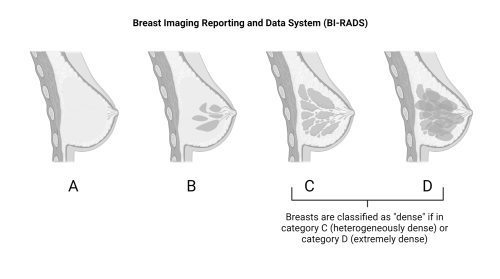
On March 9th, 2023, the FDA required “mammography facilities to notify patients about the density of their breasts” [1]. Breast density measures the amount of fibrous and glandular tissue in the breast compared to fat tissue [2]. Dense breasts, which have higher amounts of fibrous and glandular tissue and lower amounts of fat tissue, make it harder to detect breast cancer in mammograms [2]. Breast density is categorized using the Breast Imaging Reporting and Data System (BI-RADS). BI-RADS uses a scale from A to D in increasing breast density. Breasts are classified as dense if they fall in category C, heterogeneously dense, or category D, extremely dense (Figure 1). Additionally, dense breast tissue increases the risk of developing breast cancer [1]. This literature review evaluates the possible benefits of notifying women about their breast density based on the relationship between breast density and breast cancer.
Measuring Breast Density
Breast density can be screened using digital breast tomosynthesis (DBT), ultrasound (US), and digital mammography (DM). In “Digital Breast Tomosynthesis: Concepts and Clinical Practice” (2019), Alice Chong et al. compared the screening outcomes of DBT and DM [3]. DBT, a relatively new technique, stacks images three-dimensionally, which provides “localization information and improved lesion characterization” [3]. This technique increases the cancer detection rate (CDR) compared to DM alone [3].
CDR should be accurate and therefore be free of false-negatives; interval cancers, or cancers diagnosed between regular screenings, can indicate false-negative findings [3]. However, two studies in Chong et al.’s meta-study showed contrasting results in the interval cancer rates of DBT and DM. Houssami et al.’s “Screening with Tomosynthesis or Standard Mammography trial […] estimated an interval cancer rate of 1.23 per 1000 screened with DBT, compared with 1.6 per 1000 screened with [DM]” while Bahl et al.’s retrospective study “demonstrated similar interval cancer rates for DBT and [DM]” [3]. These contrasting results suggest there isn’t a clear consensus on false-negative findings in DBT. For more consistent and reliable results, longitudinal studies on the effects of DBT are necessary. This could be done by combining these screening methods and comparing the results.
In “Digital Breast Tomosynthesis Plus Ultrasound Versus Digital Mammography Plus Ultrasound for Screening Breast Cancer in Women With Dense Breasts” (2023), Su Min Ha et al. compared the cancer detection rates of DBT combined with ultrasound (US) (DBT cohort) and DM combined with US (DM cohort) in 1,195 asymptomatic women [4]. Ha et al. conducted this study from June 2016 to July 2019 at Seoul National University Hospital Healthcare System Gangnam Center on 2,589 asymptomatic women with BI-RADS categories C or D [4] . The results showed no significant difference in the cancer detection rate between the DBT and DM cohorts [4]. However, the DBT cohort showed lower specificity than the DM cohort, and the addition of ultrasound screening on both DBT and DM increased CDR [4]. This demonstrates that combining screening techniques is more effective than using one technique alone. DBT is not commonly available in most countries, but combining DM with US as an alternative can still effectively detect cancers [4].
Ha et al.’s study has some limitations. They collected data from a “single-round [of] screening,” providing no verification for their results [4]. Additionally, Ha et al. mention “selection bias exists” because they conducted their study at a “single academic institution” [4]. Since they did not use screenings from people in other locations or institutions, their results may not accurately represent all populations of women. Future studies should consider these limitations to confirm or refute Ha et al.’s. results.
Breast Density Over Time
There is consistent data supporting that breast density decreases with age [5]. In “Longitudinal Analysis of Change in Mammographic Density in Each Breast and Its Association With Breast Cancer Risk” (2023), Shu Jiang et al. measured the differences in the “rate of change of breast density in women who subsequently develop[ed] breast cancer compared to those who [did] not” [5]. This study recruited 8,710 women at the Joanne Knight Breast Health Center in Missouri from November 3rd, 2008, to April 30th, 2012 [5]. Jiang et al. assessed the volumetric mammographic breast density by dividing the dense glandular tissue by the total breast volume [5]. The data shows volumetric density change was initially higher in women who later developed breast cancer compared to those who did not [5]. Additionally, a slower rate of decrease in breast density was related to a higher risk of developing breast cancer [5]. This information can be useful when looking at trends in breast density over time in patients. If medical providers can identify that a patient’s breast density is decreasing at a slower rate than average, they can notify patients of the increased risk of developing breast cancer.
What Women Do After Being Told They Have Dense Breasts

Susan H. Busch et al. conducted a difference-in-differences study in “Association of State Breast Notification Laws With Supplemental Testing and Center Detection After Screening Mammography” (2019) to compare nine states with dense breast notification (DBN) laws and twenty-five states without DBN laws [6]. The study split the category of states with DBN laws into states with generic laws and those with more specific laws. Generic DBN laws do not require patients to be notified of the possible benefits of supplemental screening, while specific DBN laws require patients to be notified of the benefits [6]. The study used a total of 1,441,544 screening mammograms from January 1st, 2014, to December 31st, 2015, from women between 40 and 59 years old [6]. The results show a significant increase in cancer detection in states with DBN laws that notified patients of supplemental screening options [6]. This outcome indicates that women were more likely to consult their providers about supplemental testing options [6].
Busch et al. acknowledge they did not evaluate the effect of DBN laws on breast cancer mortality because the follow-up period was not long enough [6]. Additionally, Busch et al. only included individuals who were “continuously enrolled in an insurance plan for 2 years or more,” meaning the study could not measure the effect of DBN laws in individuals who switched plans [6] or those who were not under any plan at all. DBN laws could have close to no effect in women who have no health insurance. For those with low income or no health insurance, the CDC created the National Breast and Cervical Cancer Early Detection Program (NBCCEDP) in 1990 to give “access to timely breast and cervical cancer screening” [7]. Although this program aims to increase accessibility for cancer screenings, it’s not certain all people in the U.S. can get screened.
Similarly to Busch et al., Ellie Darcey et al. conducted a survey in “Post-Mammographic Screening Behaviour: A Survey Investigating What Women Do After Being Told They Have Dense Breasts” (2020) from 6,183 women in Western Australia between November 21st, 2017, to April 19th, 2018 [8]. Darcey et al. collected data on the self-reported usage of mammographic screening in women who were told and women who were not told that they had dense breasts [8]. Results showed about “half of women who have been notified they have dense breasts… consulted their doctor who appear to refer for supplemental screening around 50% of the time” [8]. However, Darcey et al. also found that “women living in remote areas are less likely to have an ultrasound,” possibly due to a lack of availability [8]. This shows that although there is an overall increase in mammographic screening when women are told they have dense breasts, there are still financial and accessibility factors that can interrupt this trend. Further research can be done in remote areas and in low-income areas to evaluate how often women undergo mammographic screenings.
The FDA Mandate
Based on these studies, the FDA mandate to notify patients of their breast density will most likely have positive effects in preventing and treating breast cancer. As seen in Busch et al.’s and Darcey et al.’s studies, there was an increase in supplemental mammographic screenings in women who were told they have dense breasts. A similar trend can be expected because of the FDA requirement. Although this mandate alone may be insufficient to prevent missed breast cancer detection opportunities due to financial and accessibility issues, the mandate may increase awareness in women with dense breasts. However, it’s uncertain whether all women will read the paper with their breast density statement. Even after reading the paper, women may not seek supplemental screening without understanding the importance of breast density. The breast density statement is only effective in increasing supplemental screenings if women fully comprehend what is written. Therefore, research specific to the effectiveness of the FDA mandate would be needed.
Conclusion
The current literature suggests breast density increases the risk of breast cancer, and proper screening can increase cancer detection. In general, notifying women of their breast density increases supplemental screenings, but it is uncertain whether women seek supplemental screening due to other factors such as accessibility, financial burdens, health insurance, or states with differing DBN laws. Additionally, the studies used in this literature review conducted research on women but not on men. Based on the statistics from previous years, it is expected that more than 2,800 men will be diagnosed with breast cancer in 2023, and about 530 men will die from it in the same year [9]. Although breast cancer research is commonly found in women, this condition also affects men, and it is necessary to include men in research as well. The FDA mandate is a step in the right direction to increasing breast cancer detection, but research needs to be continued on this topic.

About the Author: Ahya Snyder
Ahya is a class of 2024 Neurobiology, Physiology, and Behavior major. She plans to pursue a career as a podiatrist. Ahya enjoys playing the flute and is a part of the flute choir at UC Davis.
References
- FDA. FDA Updates Mammography Regulations to Require Reporting of Breast Density Information and Enhance Facility Oversight (Bt). Accessed April 30, 2023. Available from: https://www.fda.gov/news-events/press-announcements/fda-updates-mammography-regulations-require-reporting-breast-density-information-and-enhance.
- American Cancer Society. Breast Density and Your Mammogram Report (Bt). Accessed May 3, 2023. Available from: https://www.cancer.org/cancer/types/breast-cancer/screening-tests-and-early-detection/mammograms/breast-density-and-your-mammogram-report.html.
- Chong A, Weinstein SP, McDonald ES, Conant EF. 2019. Digital Breast Tomosynthesis: Concepts and Clinical Practice. Radiology [Internet]. 292(1):1-19. doi:10.1148/radiol.2019180760.
- Ha SM, Yi A, Yim D, Jang M, Kwon BR, Shin SU, Lee EJ, Lee SH, Moon WK, Chang JM. 2023. Digital Breast Tomosynthesis Plus Ultrasound Versus Digital Mammography Plus Ultrasound for Screening Breast Cancer in Women With Dense Breasts. Korean J Radiol. [Internet]. 24(4):274-283. doi:10.3348/kjr.2022.0649.
- Jiang S, Bennett DL, Rosner BA, Colditz GA. 2023. Longitudinal Analysis of Change in Mammographic Density in Each Breast and Its Association With Breast Cancer Risk. JAMA Oncol. [Internet]. E1-E7. doi:10.1001/jamaoncol.2023.0434.
- Busch SH, Hoag JR, Aminawung JA, Xu X, Richman IB, Soulos PR, Kyanko KA, Gross CP. 2019. Association of State Dense Breast Notification Laws With Supplemental Testing and Cancer Detection After Screening Mammography. AJPH [Internet]. 109(5):762-767. doi:10.2105/AJPH.2019.304967.
- CDC. About the Program (Bt). Accessed May 10, 2023. Available from: https://www.cdc.gov/cancer/nbccedp/about.htm.
- Darcey E, Hunt EJ, Keogh L, McLean K, Saunders C, Thompson S, Woulfe C, Wylie E, Stone J. 2021. Post‐Mammographic Screening Behaviour: A Survey Investigating What Women Do After Being Told They Have Dense Breasts. Health Promot J Austr. [Internet]. 32:29-39. doi:10.1002/hpja.396.
- Breast Cancer Research Foundation. What to Know About Male Breast Cancer (Bt). Accessed August 19, 2023. Available from: https://www.bcrf.org/blog/male-breast-cancer-statistics-research/.